Cyberattacks have become more advanced than ever before. Traditional perimeter-based security models are no longer sufficient to protect modern enterprises operating across cloud platforms, remote work environments, SaaS applications, and hybrid infrastructures.
This is where Zero Trust Security becomes essential. Instead of assuming users or devices inside the corporate network are trustworthy, Zero Trust follows one simple principle: Never Trust, Always Verify.
Leading organizations worldwide—including Fortune 500 companies, financial institutions, healthcare providers, and government agencies—are rapidly adopting Zero Trust Architecture (ZTA) to strengthen cybersecurity, reduce ransomware risks, and secure digital transformation initiatives.
What is Zero Trust Security?
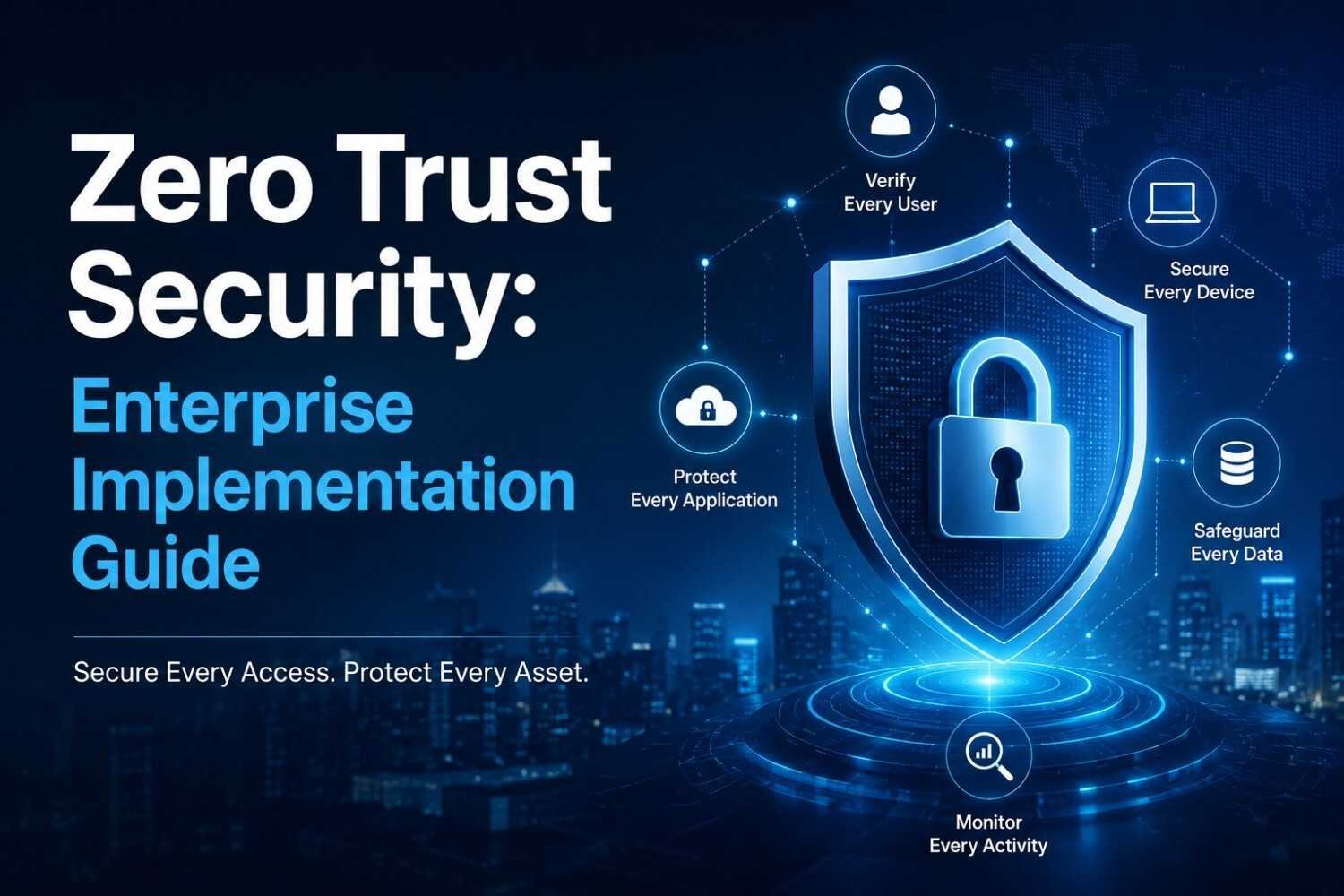
Zero Trust Security is a cybersecurity framework that requires continuous verification of every user, device, application, and network request before granting access to enterprise resources.
Unlike traditional security models that trust users once they are inside the network, Zero Trust assumes every request could be malicious and validates identity, device health, location, risk level, and permissions continuously.
Core principles include:
- Verify every access request
- Enforce least-privilege access
- Continuously monitor user activity
- Segment networks
- Authenticate devices
- Protect sensitive data
- Detect threats in real time
Why Enterprises Need Zero Trust Security
Modern businesses face growing cybersecurity challenges such as ransomware attacks, insider threats, cloud misconfigurations, credential theft, phishing attacks, remote workforce vulnerabilities, third-party vendor risks, and AI-powered cyberattacks. Zero Trust minimizes these risks by validating every access request instead of relying on network location.
Core Components of Zero Trust Architecture
1. Identity and Access Management (IAM)
IAM ensures that only verified users can access business resources using identity-based authentication. Key features include Single Sign-On (SSO), identity governance, role-based access control, Privileged Access Management (PAM), and risk-based authentication.
2. Multi-Factor Authentication (MFA)
Passwords alone are no longer enough. MFA combines multiple verification methods such as password, mobile authentication, biometrics, hardware security keys, and One-Time Passwords (OTP).
3. Zero Trust Network Access (ZTNA)
ZTNA replaces traditional VPNs by granting application-specific access rather than exposing the entire network. Benefits include better user experience, reduced attack surface, secure remote access, and continuous verification.
4. Endpoint Security
Every connected device must meet security standards before gaining access. Endpoint protection includes antivirus, EDR (Endpoint Detection & Response), device compliance, patch management, and disk encryption.
5. Network Segmentation
Micro-segmentation divides enterprise networks into smaller security zones. Advantages include stopping lateral movement, limiting ransomware spread, protecting critical systems, and improving compliance.
6. Continuous Monitoring
Zero Trust continuously analyzes user behavior, device health, login locations, risk scores, application access, and network traffic. AI-powered analytics help detect suspicious activity before damage occurs.
Zero Trust Implementation Roadmap
- Identify Critical Assets – Catalog servers, databases, SaaS applications, cloud workloads, endpoints, and sensitive data.
- Classify Users – Segment users into employees, contractors, vendors, partners, administrators, and executives.
- Verify Every Identity – Implement MFA, adaptive authentication, conditional access, and passwordless login.
- Secure Devices – Ensure all endpoints comply with security policies before accessing enterprise resources.
- Apply Least Privilege – Users receive only the minimum permissions required for their roles.
- Segment Networks – Separate finance, HR, production, development, cloud environments, and IoT devices.
- Monitor Continuously – Use SIEM, XDR, UEBA, and AI Security Analytics.
Benefits of Zero Trust Security
- Reduced ransomware risk
- Improved regulatory compliance
- Better cloud security
- Stronger identity protection
- Secure remote work
- Lower insider threat exposure
- Enhanced visibility across IT environments
- Faster incident response
- Simplified access management
- Increased customer trust
Zero Trust vs Traditional Security
| Feature | Traditional Security | Zero Trust Security |
|---|---|---|
| Trust Model | Trust inside network | Never trust, always verify |
| Authentication | One-time | Continuous |
| Network Access | Broad | Granular |
| Remote Access | VPN | ZTNA |
| Threat Detection | Reactive | Continuous |
| Insider Protection | Limited | Strong |
| Cloud Support | Moderate | Excellent |
Future Trends in Zero Trust
- AI-powered threat detection
- Passwordless authentication
- Behavioral biometrics
- Autonomous security operations
- Unified identity platforms
- Secure Access Service Edge (SASE)
- Continuous adaptive trust scoring
- Extended Detection and Response (XDR)
Frequently Asked Questions (FAQ)
What is Zero Trust Security?
Zero Trust Security is a cybersecurity model that continuously verifies every user, device, and application before granting access.
Why is Zero Trust important?
It reduces the risk of data breaches, ransomware, insider threats, and unauthorized access in modern enterprise environments.
Is Zero Trust only for large enterprises?
No. Organizations of all sizes can adopt Zero Trust principles, scaling implementation based on their needs and resources.
Does Zero Trust replace VPNs?
In many cases, Zero Trust Network Access (ZTNA) can replace or reduce reliance on traditional VPNs by providing more granular, application-specific access.
Conclusion
Zero Trust Security is no longer an optional cybersecurity strategy—it has become a foundational approach for protecting modern enterprises. By adopting identity-centric access controls, least-privilege principles, continuous monitoring, and network segmentation, organizations can significantly reduce cyber risks while supporting cloud adoption and remote work.
A phased implementation, combined with ongoing monitoring and employee awareness, helps organizations strengthen resilience against evolving threats. As cyberattacks continue to grow in sophistication, investing in a well-designed Zero Trust Architecture positions businesses for a more secure and adaptable future.