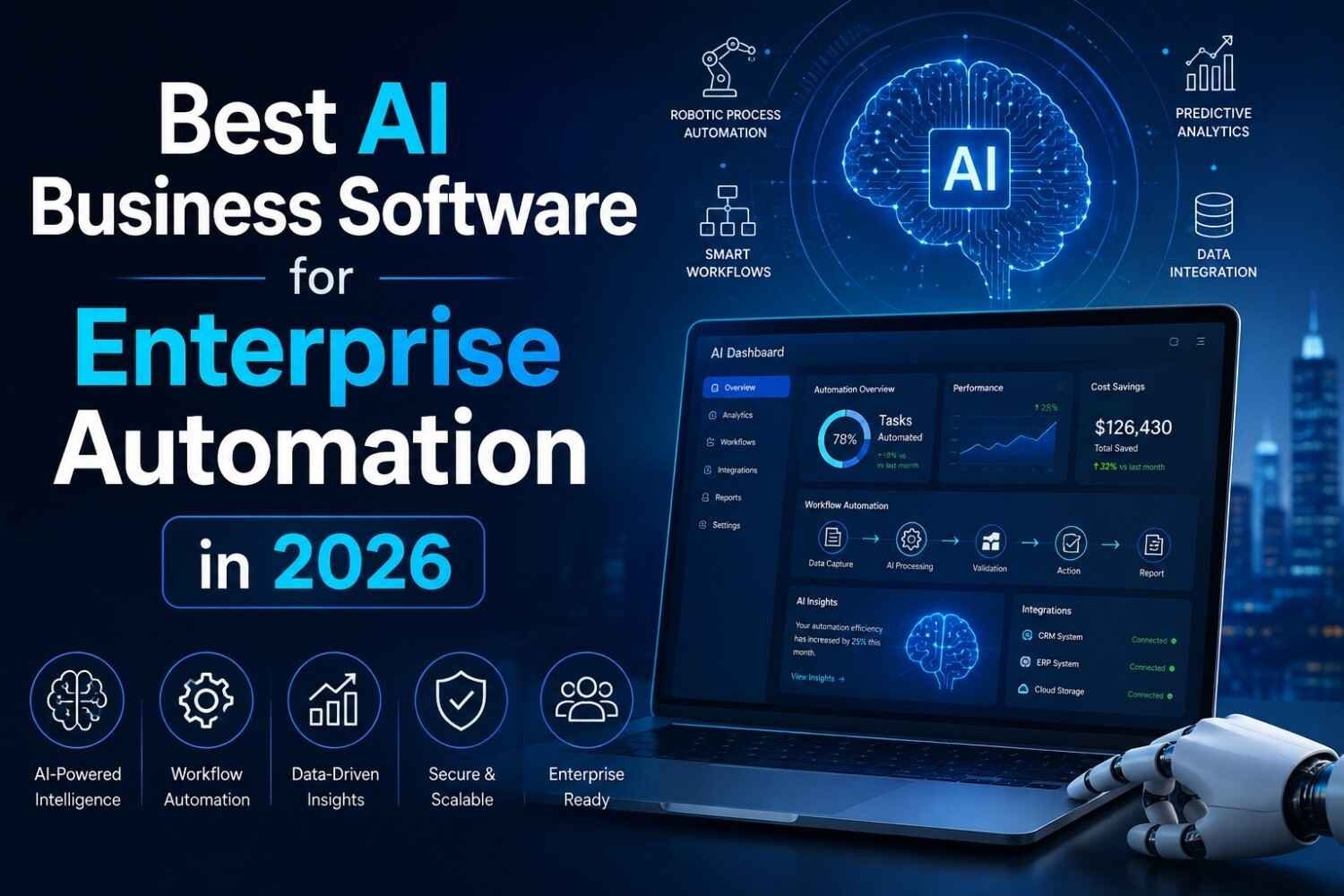
Businesses in 2026 are rapidly embracing Artificial Intelligence (AI) to automate repetitive tasks, improve decision-making, enhance customer experiences, and reduce operational costs. Whether you're a growing company or a global enterprise, investing in the right AI business software can dramatically improve efficiency and profitability.
Enterprise automation has evolved beyond simple workflow management. Modern AI platforms now integrate machine learning, predictive analytics, natural language processing, robotic process automation (RPA), and cloud computing into a unified ecosystem that transforms business operations.
This guide explores the best AI business software for enterprise automation in 2026, their key features, benefits, and how to choose the ideal solution for your organization.
What is AI Business Software?
AI business software uses artificial intelligence technologies to automate business processes, analyze data, optimize workflows, and assist employees with intelligent recommendations.
Unlike traditional business applications, AI-powered platforms continuously learn from data, identify patterns, and improve decision-making over time. These systems are commonly used for Customer Relationship Management (CRM), Enterprise Resource Planning (ERP), Finance Automation, HR Management, Supply Chain Optimization, Sales Forecasting, Customer Support, IT Operations, Marketing Automation, and Cybersecurity.
Why Enterprise Automation Matters in 2026
Organizations face increasing pressure to reduce costs while maintaining productivity and delivering exceptional customer experiences. AI-driven automation helps businesses reduce operational expenses, increase employee productivity, improve customer satisfaction, accelerate decision-making, minimize manual errors, enhance data security, enable scalable growth, and gain competitive advantages.
Key Features to Look for in AI Business Software
- Intelligent Workflow Automation – Automates approvals, reporting, invoicing, and document processing.
- Predictive Analytics – Forecasts sales trends, customer behavior, and operational risks.
- AI-Powered CRM – Enhances lead scoring, customer engagement, and personalized marketing.
- Cloud Integration – Supports secure access and scalability across departments.
- Robotic Process Automation (RPA) – Automates repetitive tasks with high speed and accuracy.
- Business Intelligence Dashboards – Provides real-time insights and actionable analytics.
- Natural Language Processing (NLP) – Enables conversational interfaces and intelligent search.
- Enterprise Security – Includes advanced threat detection and compliance management.
Top Benefits of AI Enterprise Automation
Increased Productivity
Employees spend less time on repetitive tasks and more time on strategic work.
Cost Savings
Automation reduces labor costs, minimizes errors, and streamlines operations.
Better Customer Experience
AI chatbots, personalized recommendations, and predictive customer support improve satisfaction.
Smarter Decision Making
Executives gain access to real-time dashboards and predictive insights.
Enhanced Compliance
AI systems automatically monitor regulatory requirements and generate audit-ready reports.
AI ERP vs AI CRM
AI ERP
AI ERP systems manage finance, inventory, procurement, manufacturing, and operations through intelligent automation. Ideal for large enterprises, manufacturing companies, supply chain management, and finance departments.
AI CRM
AI CRM focuses on customer relationships, sales automation, marketing campaigns, and customer service. Ideal for sales teams, marketing departments, customer support, and lead management.
Many enterprises integrate both AI ERP and AI CRM for end-to-end business optimization.
Future Trends in Enterprise Automation
- Generative AI assistants for employees
- Autonomous business operations
- AI-powered digital twins
- Hyperautomation across departments
- Explainable AI for compliance
- AI-driven cybersecurity
- Edge AI for real-time decision making
- Advanced predictive analytics
- Low-code AI automation platforms
- Intelligent process mining
How to Choose the Best AI Business Software
Consider business requirements, industry-specific features, integration capabilities, security certifications, scalability, AI capabilities, customer support, pricing model, implementation timeline, and Return on Investment (ROI).
Frequently Asked Questions (FAQs)
What is enterprise automation?
Enterprise automation uses AI and software to automate business processes, reducing manual work and improving operational efficiency.
Which industries benefit the most from AI business software?
Banking, healthcare, manufacturing, retail, logistics, insurance, education, and technology companies are among the biggest beneficiaries.
Is AI business software suitable for small businesses?
Yes. Many cloud-based AI solutions are scalable and offer plans designed for small and medium-sized businesses.
What is the difference between AI ERP and AI CRM?
AI ERP focuses on managing core business operations, while AI CRM is designed to improve customer relationships, sales, and marketing activities.
Conclusion
AI business software has become a cornerstone of enterprise automation in 2026. By combining intelligent workflow automation, predictive analytics, cloud computing, and machine learning, organizations can streamline operations, reduce costs, and improve customer experiences.
Whether you're implementing an AI-powered ERP, CRM, business intelligence platform, or workflow automation solution, the key is selecting software that aligns with your organization's goals, integrates seamlessly with existing systems, and scales as your business grows.
Enterprises that invest strategically in AI today are better positioned to achieve operational excellence, accelerate innovation, and remain competitive in an increasingly digital business landscape.