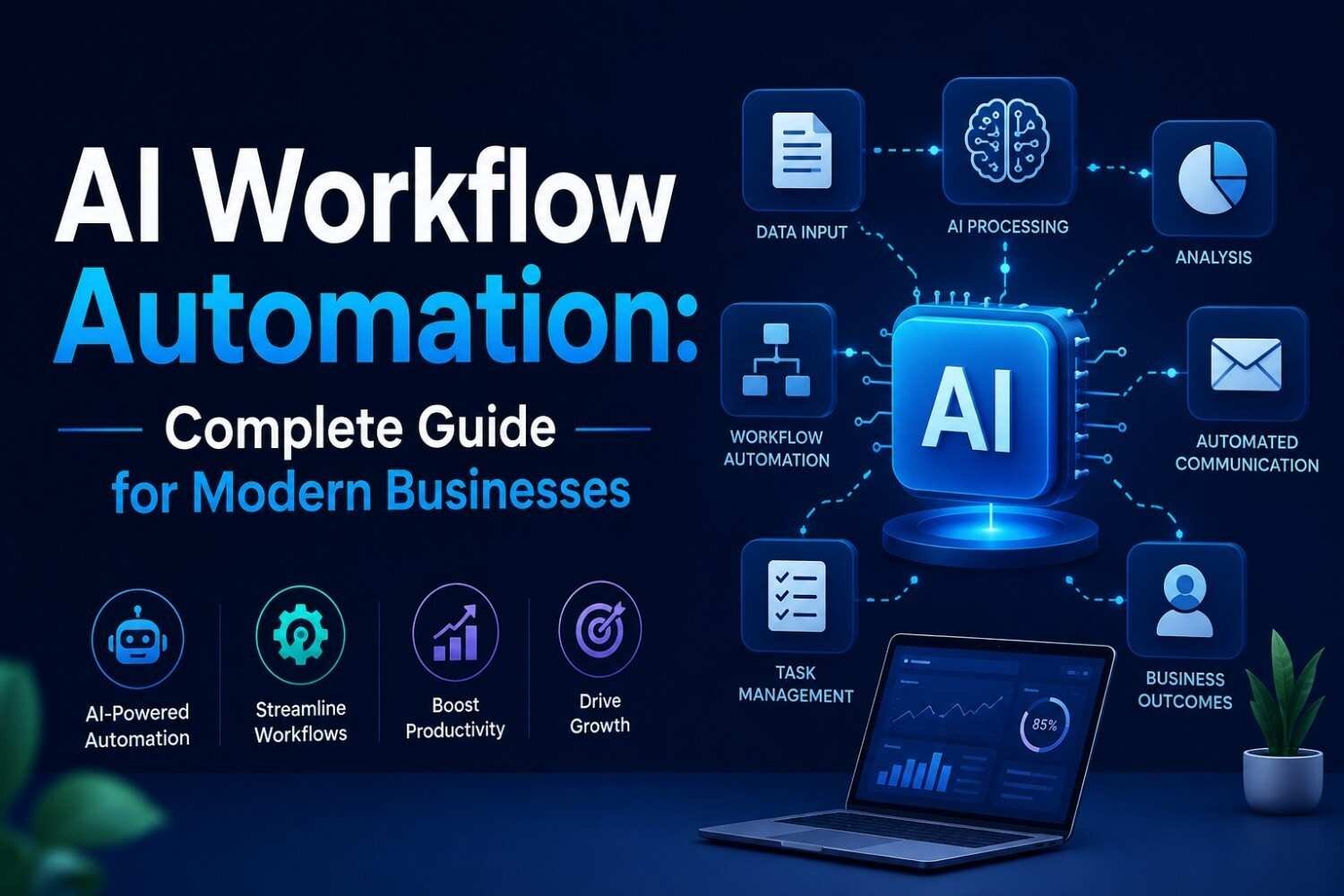
Artificial Intelligence is transforming the way businesses operate. In today's competitive market, companies are increasingly adopting AI Workflow Automation to streamline repetitive tasks, improve operational efficiency, reduce costs, and deliver better customer experiences.
Whether you're a startup, SME, or global enterprise, AI-powered automation enables organizations to work smarter instead of harder. From finance and HR to customer service and marketing, AI is becoming the backbone of modern business operations.
What is AI Workflow Automation?
AI Workflow Automation refers to the use of Artificial Intelligence technologies to automate business processes, repetitive tasks, and decision-making workflows with minimal human intervention.
Unlike traditional automation, AI-powered systems can learn from data, understand documents, analyze customer behavior, predict outcomes, make intelligent decisions, and improve over time.
It combines technologies such as Machine Learning (ML), Natural Language Processing (NLP), Robotic Process Automation (RPA), Computer Vision, Predictive Analytics, and Generative AI. This combination allows businesses to automate both simple and complex workflows.
Why Businesses Need AI Workflow Automation
Modern businesses face several operational challenges: manual data entry, employee workload, human errors, slow approvals, inefficient communication, high operational costs, and poor customer experience.
AI automation solves these issues by creating intelligent workflows that operate 24/7 without interruption. Organizations implementing AI automation often experience faster operations, reduced labor costs, higher productivity, better compliance, improved customer satisfaction, and increased profitability.
How AI Workflow Automation Works
- Data Collection – Information is gathered from emails, forms, CRM systems, ERP software, databases, APIs, and documents.
- AI Processing – Artificial Intelligence analyzes customer requests, purchase history, business documents, employee data, and financial reports.
- Decision Making – AI determines which department should receive the request, whether an invoice is approved, which customer needs follow-up, or which support ticket has higher priority.
- Workflow Execution – The automation platform performs actions automatically such as sending emails, updating CRM, generating reports, scheduling meetings, creating invoices, and notifying employees.
- Continuous Learning – Machine learning continuously improves workflow performance using historical business data.
Benefits of AI Workflow Automation
1. Increased Productivity
Employees spend less time on repetitive work and more time on strategic initiatives.
2. Lower Operating Costs
Automation reduces staffing requirements for repetitive tasks while minimizing costly errors.
3. Faster Decision Making
AI analyzes vast amounts of data in seconds, enabling quicker and more accurate decisions.
4. Better Customer Experience
AI-powered chatbots and automated workflows provide faster responses, personalized recommendations, and seamless support.
5. Improved Compliance
Automated audit trails, policy enforcement, and standardized processes help organizations meet regulatory requirements.
6. Enhanced Accuracy
AI minimizes human errors in data entry, invoicing, reporting, and document processing.
7. Scalability
Businesses can automate thousands of processes without proportionally increasing workforce size.
Key Features of AI Workflow Automation Software
- AI-powered document processing
- Workflow builder
- Drag-and-drop automation
- Predictive analytics
- OCR technology
- API integrations
- Process mining
- Intelligent routing
- Approval workflows
- Dashboard and reporting
- Cloud deployment
- Security controls
- Role-based access
- Low-code development
Top Business Areas Using AI Workflow Automation
Human Resources
Resume screening, employee onboarding, payroll processing, leave management, and performance tracking.
Finance
Invoice automation, expense approvals, fraud detection, budget forecasting, and financial reporting.
Sales & Marketing
Lead qualification, CRM updates, proposal generation, email automation, sales forecasting, campaign automation, customer segmentation, AI content generation, and personalized recommendations.
Customer Support
AI chatbots, ticket routing, automated responses, knowledge management, and sentiment analysis.
Supply Chain
Inventory management, demand forecasting, purchase approvals, vendor management, and shipment tracking.
Best AI Workflow Automation Software in 2026
- Microsoft Power Automate
- UiPath
- Automation Anywhere
- Workato
- Zapier
- Make
- Salesforce Flow
- ServiceNow
- Nintex
- Pega Platform
Future Trends in AI Workflow Automation
- Autonomous AI agents managing end-to-end workflows
- Hyperautomation combining AI, RPA, and analytics
- Voice-driven workflow management
- Generative AI embedded in business processes
- Predictive and self-healing workflows
- Industry-specific AI automation solutions
Frequently Asked Questions (FAQs)
What is AI Workflow Automation?
AI Workflow Automation uses artificial intelligence to automate business processes, enabling systems to make decisions, process information, and execute tasks with minimal human involvement.
How does AI differ from traditional workflow automation?
Traditional automation follows predefined rules, while AI automation can learn from data, adapt to changing conditions, and make intelligent decisions.
Is AI Workflow Automation suitable for small businesses?
Yes. Many cloud-based platforms offer affordable solutions that help small businesses automate routine tasks, improve efficiency, and scale operations.
Conclusion
AI Workflow Automation is no longer a futuristic concept it's a strategic necessity for modern businesses. By combining artificial intelligence with workflow management, organizations can automate repetitive tasks, improve operational efficiency, reduce costs, and make smarter decisions.
Whether you're a small business seeking productivity gains or a large enterprise driving digital transformation, investing in AI workflow automation can provide a significant competitive advantage. Start with high-impact processes, choose the right platform, and continuously optimize your workflows to unlock the full potential of AI-driven automation.